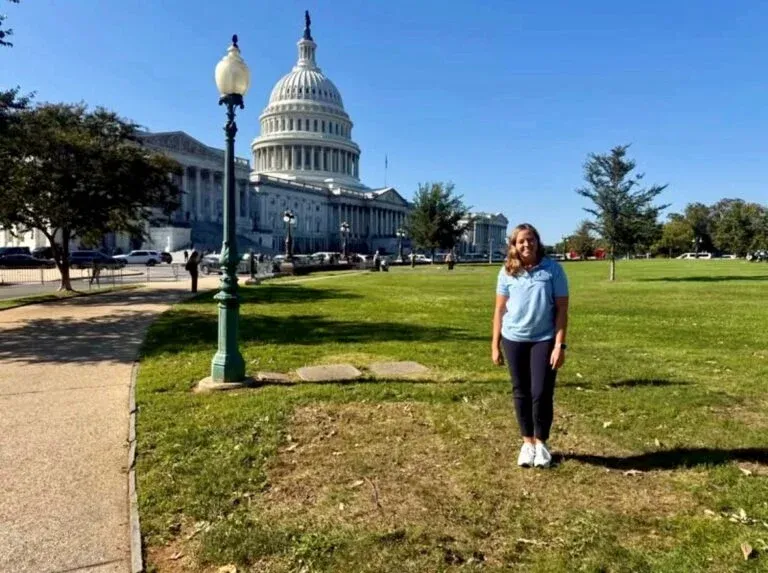
Lydia Epping, a Crestview Hills resident and cancer survivor, traveled to Washington, D.C. the week of Sept. 14 to press Kentucky's congressional delegation on cancer research funding.
Epping joined more than 750 cancer patients, survivors and loved ones for the American Cancer Society Cancer Action Network's (ACS CAN) annual Leadership Summit and Lobby Day, a three-day event that began Monday, Sept. 14, the Northern Kentucky Tribune reported.
Diagnosed with kidney cancer at age seven, Epping met with Kentucky's congressional delegation to push for increased funding at the National Institutes of Health (NIH), the National Cancer Institute (NCI) and the Centers for Disease Control and Prevention (CDC). She also urged lawmakers to pass the Clinical Trial Modernization Act (CTMA), a bipartisan bill that would reduce barriers to clinical trial participation.
Advocates from all 50 states attended the summit. They asked Congress to provide $51.3 billion for NIH and $7.99 billion for NCI in fiscal year 2027, according to the Alabama Political Reporter.
The funding request comes after Congress rejected a White House proposal to cut NIH and NCI budgets by up to 40 percent. Lawmakers instead increased NIH's fiscal 2026 budget by $415 million and NCI's by $128 million.
Federal cancer research funding has contributed to a 34% decline in cancer mortality rates over the past 35 years, according to ACS CAN.
The CTMA, sponsored in the Senate by Sens. Tim Scott, R-S.C., and Mark Warner, D-Va., would let clinical trial sponsors cover participants' costs including copays, travel, parking, food and lodging. It would also allow sponsors to provide technology for remote participation. Up to $2,000 per year in trial-related financial support would be exempt from federal income tax and would not count toward Medicaid income eligibility, according to an ACS CAN summary of the bill.
About 20% of cancer clinical trials fail because they cannot enroll enough patients, ACS CAN said. The bill targets underrepresented groups including rural residents, older adults, certain racial and ethnic communities and people with limited incomes.
Lisa A. Lacasse, president of ACS CAN, said in a statement in May when the Senate version was introduced that the bill "would help remove cost and geographic barriers to clinical trials and help ensure that more patients have a chance to enroll in the best treatment options available here in the U.S."
The CTMA's House version, H.R. 3521, was introduced in May 2025 by Reps. Raul Ruiz, D-Calif., and August Pfluger, R-Texas. No vote has been scheduled.
Upcoming community events
- The Crescent Springs and Villa Hills Fall Fest returns Saturday, Sept. 19.
- Reservations for the Crestview Hills 75th anniversary dinner close Monday, Sept. 21.